
Introduction
Mauritius is emerging as a credible jurisdiction for crypto businesses seeking a regulated base for virtual asset operations. Under the Virtual Asset and Initial Token Offerings Services Act 2021 (“VAITOS Act”), the jurisdiction provides a dedicated legal framework, oversight by the Financial Services Commission (“FSC”), and a licensing regime organized into distinct categories of virtual asset activity. For businesses looking for regulatory clarity, defined license pathways, and international structuring potential, Mauritius is becoming a serious option for virtual asset service provider (“VASP”) establishment.
VASP license classes in Mauritius
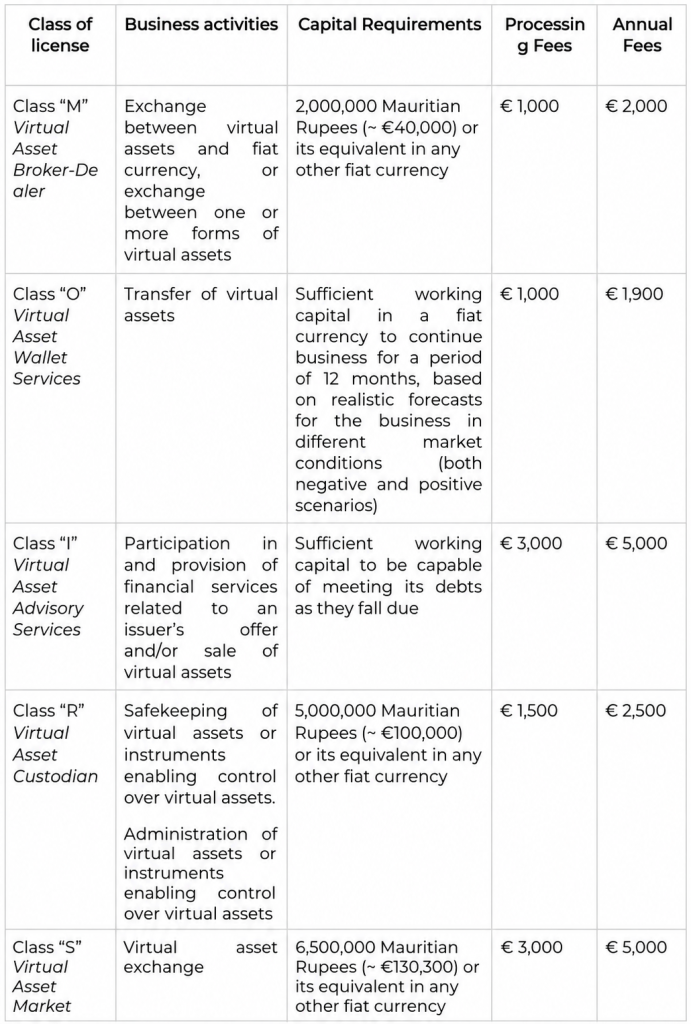
The VASP regime is divided into five distinct license classes, each linked to a specific type of regulated activity. In addition to the activity scope, applicants should also consider the applicable capital threshold and FSC fees for each class. Under the VAITOS (Capital and Other Financial Requirements) Rules 2022, a VASP must at all times maintain the greater of its own funds requirement, its prudential requirement, or any higher amount imposed by the FSC; where multiple VASP licenses are held, the capital requirement is combined across the relevant classes.
Obtaining a VASP license in Mauritius
Obtaining a VASP license in Mauritius is generally a staged process involving document preparation, filing with the FSC, and follow-up with the regulator until a decision is issued.
Step 1. Collection of information
The process begins with the collection of the core information and supporting documents required for the application. At this stage, the applicant typically prepares the company’s incorporation documents, a business plan or feasibility study, details of the proposed business and governance arrangements, and the principal compliance policies and measures required under the Mauritian regulatory framework.
The FSC also expects due diligence information on the persons involved in the structure, including the applicant’s promoters, beneficial owners, controllers, and directors. Depending on the proposed setup, supporting confirmations or consents from relevant service providers or advisers may also be required.
Step 2. Preparing application forms and compiling the submission
Once the relevant information has been collected, the application forms and questionnaires must be completed and the full submission package compiled. This stage usually includes reviewing the proposed structure, confirming the relevant office-holders and functionaries, checking that the documentation is consistent, and finalizing the corporate and application materials for submission to the FSC.
In practice, this is the stage at which the application is shaped into a complete filing package rather than a collection of standalone documents.
Step 3. Filing the application with the FSC
After the application package is finalized, it is formally filed with the FSC along with the applicable regulatory fees.
Step 4. Follow-up and liaising with the FSC
Following submission, the process typically proceeds to a review phase, during which the FSC may raise queries or request additional information. The applicant is expected to engage with the regulator and respond to these points until the FSC reaches a decision on the application.
Indicative timeline
As an indicative timeframe, the licensing process is commonly described as taking around three months from the date of lodging the application, although the actual timing will depend on the FSC’s workload, the complexity of the structure, and the extent of any follow-up questions raised during the review.
Ongoing obligations after licensing
Once licensed, a VASP must continue to comply with the ongoing requirements of the Mauritian regime. In broad terms, this includes maintaining the applicable financial requirements prescribed by FSC rules and submitting audited financial statements to the FSC within the required period after the end of each financial year.
Key office-holders and functionaries
A Mauritian VASP application is not assessed only at the entity level. The FSC also focuses on the suitability of the individuals who will perform key roles within the structure. In practice, the application typically identifies and supports a governance and compliance framework that includes the following office-holders and functionaries:
- Directors – the applicant is expected to appoint an appropriately constituted board. This includes at least three fit and proper directors, with 30% independent directors, and at least one director resident in Mauritius.
- Compliance Officer – the structure should include a designated Compliance Officer with the appropriate experience, supporting documentation, and evidence that the person satisfies the applicable Mauritian regulatory standards.
- Money Laundering Reporting Officer (“MLRO”) and Deputy Money Laundering Reporting Officer (“DMLRO”) – these roles are central to the applicant’s AML/CFT framework and must be supported by the necessary due diligence materials, competency confirmations, and evidence of compliance with the applicable Financial Intelligence and Anti-Money Laundering Act (“FIAML”) requirements.
- Company Secretary – the applicant is also expected to appoint a secretary, with the relevant supporting information and approvals where required.
As part of the licensing process, the FSC generally expects these individuals to be properly identified, documented, and assessed as suitable for their proposed roles within the VASP.
Conclusion
Mauritius is emerging as a credible jurisdiction for virtual asset businesses that want a regulated, structured, and internationally oriented setup rather than a purely nominal offshore solution. With a dedicated VASP framework, clearly defined license classes, an established application process, and ongoing regulatory oversight by the FSC, Mauritius offers a practical foundation for crypto businesses looking to build with greater legal certainty and long-term strategic value.
At the same time, the success of a VASP licensing project largely depends on proper structuring, accurate preparation of the application package, and effective interaction with the regulator throughout the process.
Manimama Law Firm provides comprehensive legal and regulatory support for obtaining a VASP license in Mauritius, guiding clients through each stage of the process.
We are committed to delivering tailored legal solutions and supporting our clients at every stage of launching and operating a virtual asset business.
At Manimama Law Firm
At Manimama Law Firm, we assist businesses in navigating this regulatory environment. We support documentation, manage application processes, and develop long-term compliance strategies for crypto-related businesses.
Our Contacts
If you would like to become our client or partner, please do not hesitate to contact us at support@manimama.eu.
Alternatively, you can use our Telegram @ManimamaBot, and we will respond to your inquiry.
We also invite you to visit our website.
Join our Telegram to receive news in a convenient way: Manimama Legal Channel.
The content of this article is intended to provide a general guide to the subject matter, not to be considered as a legal consultation.