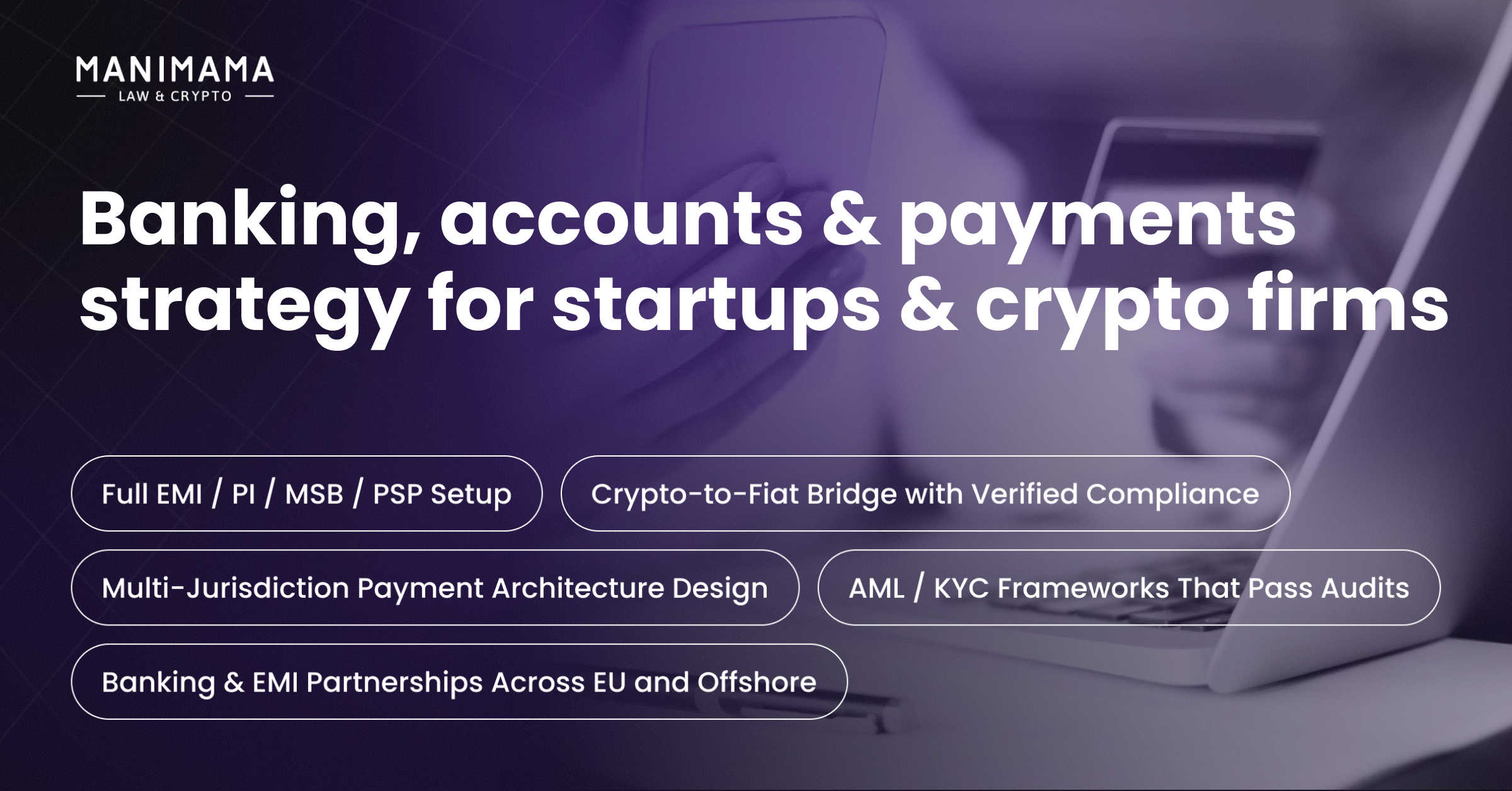

A banking, accounts, and payments strategy is a comprehensive operational framework that governs how a corporate entity manages its capital, processes daily transactions, and interacts with global financial institutions. For modern technology ventures, this definition extends far beyond traditional fiat checking accounts. It encompasses complex crypto treasury management, strategic use of stablecoins for liquidity, and integration of decentralized payment gateways. Establishing this robust infrastructure enables high-growth startups to scale efficiently, avoid devastating account freezes, and guarantee the absolute security of both corporate and client assets.
Today, the global financial landscape for Web3 companies and digital startups has undergone a radical transformation driven by technological innovation and intensified regulatory scrutiny. The transition from legacy traditional banking to agile fintech solutions has become an absolute necessity, primarily because classical banks continue to exhibit severe risk aversion toward businesses dealing with virtual assets. The rigid enforcement of KYC (Know Your Customer) and AML (Anti-Money Laundering) protocols creates massive bottlenecks for opening standard corporate accounts, forcing modern enterprises to seek alternative financial avenues. Simultaneously, offshore banking has experienced a resurgence, offering tailored flexibility and privacy, though it is accompanied by distinct reputational and compliance risks that must be carefully managed.
Treasury management challenges & strategy overview
A successful startup banking strategy demands a highly sophisticated, multi-layered approach to corporate finance from the founding team. Integrating cryptocurrency payments through platforms like BitPay is merely the tip of the operational iceberg, as companies must actively address complex issues such as tax reporting, volatility hedging, and secure asset custody.
The critical dilemma between utilizing omnibus accounts versus deploying segregated wallets has become the central focus for ensuring ultimate client trust and regulatory compliance. As of March 2026, with sweeping frameworks like MiCA and DAC8 fully enforced across Europe, an effective treasury strategy requires not only cutting-edge technological tools but also flawless legal support to protect the business amidst relentless regulatory evolution.
Managing corporate finances within the Web3 sector and the broader innovation economy is an exceptionally complex endeavor that extends well beyond standard bookkeeping practices. The specific challenges faced by modern treasury companies include navigating the extreme volatility of digital assets, adapting to sudden shifts in global regulatory environments, and overcoming the outright refusal of many traditional banks to service high-risk industries.
Consequently, designing a specialized, resilient treasury management strategy is critical to ensuring the business’s uninterrupted operational continuity. Transitioning from outdated, localized financial models to globally integrated digital solutions allows startups to pivot rapidly in volatile markets and deploy their liquidity with maximum efficiency. The role of specialized legal and financial consulting firms in this transition is truly invaluable, as they guide founders through the labyrinth of account opening, payment gateway integration, and compliant asset custody under the stringent legal realities of 2026.
Traditional banking vs fintech – digital revolution in 2026
The digital financial revolution has fundamentally altered how global businesses interact with monetary institutions and manage their capital reserves. In 2026, fierce competition between deeply entrenched traditional banks and highly agile fintech startups reached its peak, providing corporate treasurers with an unprecedented array of wealth management tools. To build an impenetrable digital banking strategy, entrepreneurs must objectively analyze the distinct strengths, weaknesses, and regulatory burdens of both traditional and alternative financial systems. Selecting the optimal financial partner directly determines the speed of cross-border settlements, the magnitude of operational fees, and the business’s overall resilience against unexpected regulatory audits. Advantages of Traditional Banks
Traditional banking institutions remain the undisputed foundation of the global macroeconomic system, offering unparalleled financial stability and absolute regulatory comfort to their clients. The primary advantage of partnering with these legacy institutions is the explicit provision of state-backed deposit insurance, which is an indispensable requirement for attracting large institutional investors and massive corporate treasuries.
Maintaining an active corporate account at a globally recognized, tier-one bank significantly elevates a startup’s reputation in the eyes of conservative partners, B2B clients, and regulatory bodies. These classical financial institutions also provide a comprehensive suite of ancillary corporate services, including customized credit facilities, complex trade finance instruments, and highly sophisticated liquidity management products that fintechs struggle to match.
However, in the fast-paced environment of 2026, the inherent operational flaws of traditional banking have become increasingly detrimental, particularly for rapidly scaling technology companies. The corporate onboarding process can easily drag on for several agonizing months due to heavily bureaucratized compliance procedures and the severe intensification of KYC protocols mandated by the newly implemented DAC8 directive.
The vast majority of traditional banks still harbor a deep-seated institutional crypto aversion, which frequently results in the sudden, unexplained freezing of accounts associated with virtual asset transactions. Additional significant drawbacks include exorbitant fees for international wire transfers, frustratingly slow settlement times, and severely limited API integration capabilities that hinder the automated scaling of modern digital business models.
Advantages & disadvantages of fintech solutions
Fintech companies, electronic money institutions (EMIs), and digital-first neobanks offer a radically different value proposition heavily optimized for speed, technological integration, and unparalleled user experience.
These modern payment institutions allow founders to open fully functional corporate accounts online within a matter of days, making them the premier choice for rapidly deploying new business entities. They provide seamless, native API integration with popular cloud accounting software and offer significantly reduced foreign exchange fees for high-volume cross-border payments. A critical strategic advantage is their inherently crypto-friendly compliance policy, which empowers Web3 startups to freely and legally convert fiat capital into cryptocurrency and vice versa without fear of sudden account termination.
Despite their overwhelming technological superiority, fintech solutions entail substantial risks that must be carefully evaluated when forming a holistic asset management treasury strategy. Neobanks frequently operate under restricted EMI licenses rather than full banking charters, meaning client funds may not be protected by national deposit insurance schemes, thereby reducing overall systemic stability.
Regulatory risks are also notably higher in this sector; agile fintech platforms can abruptly alter their internal compliance algorithms or temporarily freeze client accounts due to automated triggers for suspicious activity, with little human recourse. Therefore, industry best practices dictate combining agile fintech tools for daily operational expenditures with highly secure traditional bank accounts for the long-term safeguarding of core corporate reserves.
Offshore banking for crypto & startups
Offshore banking contOffshore banking continues to play a highly strategic, and at times controversial, role in the financial architecture of globally distributed startups and digital nomad enterprises. What these specialized jurisdictions have in common is their high degree of corporate confidentiality, exceptionally flexible tax planning opportunities, and a generally much higher institutional tolerance for cryptocurrency-related business models.
Offshore financial institutions frequently provide seamless access to diverse multi-currency accounts and international investment brokerage platforms, which greatly facilitate rapid global market expansion. For tech companies operating in regions plagued by severe economic instability or strict capital controls, offshore accounts serve as an indispensable tool for risk diversification and the ultimate protection of corporate assets against localized financial crises.
Simultaneously, leveraging offshore financial instruments in 2026 is accompanied by an unprecedented intensification of international regulatory pressure and compliance scrutiny. The aggressive global implementation of the Common Reporting Standard (CRS) and the stringent enforcement of FATF recommendations have rendered offshore compliance processes exceptionally rigorous and transparent.
Successfully opening an offshore corporate account now requires absolute proof of real economic substance within the chosen jurisdiction, which significantly increases initial setup and ongoing operational costs. Moreover, maintaining an offshore banking presence can trigger severe reputational red flags with conservative European or North American partners, drastically complicating the successful completion of their internal corporate due diligence procedures.
Corporate cryptocurrency accounts – opening & management
Opening a dedicated corporate cryptocurrency account has transitioned from a niche advantage to an absolute operational necessity for any firm seeking to compete in the borderless digital economy. This specialized account allows a legal entity to legitimately acquire, trade, and custody digital assets on its official balance sheet, forming the very core of modern cryptocurrency management. The intricate process of opening and actively managing these institutional accounts requires meticulous documentation, a thorough understanding of global AML frameworks, and strategic engagement with specialized legal counsel. Cryptocurrency exchanges and regulated institutional custodians impose extraordinarily strict compliance demands on corporate clients, meaning successful onboarding relies entirely on the immaculate quality of the submitted legal paperwork.
Advantages & challenges of crypto accounts
Corporate cryptocurrency accounts grant modern businesses a diverse array of undeniable strategic advantages that are fundamentally impossible to replicate within the legacy fiat financial system. The most transformative benefit is the unhindered ability to execute instantaneous, borderless international transfers without relying on the slow, expensive network of traditional correspondent banking relationships.
Transaction fees associated with using blockchain networks, particularly when settling high-value B2B invoices via stablecoins, remain substantially lower than those for traditional wire transfers, allowing startups to significantly optimize their global operational margins. Additionally, holding a verified corporate account on a fully licensed, top-tier exchange guarantees uninterrupted global access to deep liquidity pools and advanced financial derivatives for sophisticated market hedging.
Conversely, the institutional management of these digital assets presents formidable corporate challenges, the most prominent being the stringent requirements of KYC and AML compliance. Companies are legally obligated to transparently disclose all ultimate beneficial owners (UBOs), provide exhaustive cryptographic proof regarding the Source of Funds, and submit to rigorous, periodic external financial audits.
The notorious historical volatility of the broader cryptocurrency market creates massive operational hurdles for predictable financial planning, treasury budgeting, and accurate monthly accounting reconciliation. Furthermore, there remains a persistent, systemic risk of suddenly losing access to vital fiat off-ramps due to partner banks’ continued risk-aversion policies, forcing treasurers to constantly secure redundant backup channels for fiat conversion.
Stages of cooperation with Manimama Law Firm for account opening
Partnering with a specialized, Web3-native legal consulting firm like Manimama is the proven key to successfully navigating the grueling process of opening corporate crypto accounts in the highly regulated environment of 2026. The structured engagement typically commences with a comprehensive, deep-dive consultation in which expert attorneys meticulously analyze the client’s specific business model, tokenomics, and target demographics to identify the optimal regulatory jurisdictions.
The subsequent critical stage involves the rigorous preparation of all required legal documentation, encompassing the drafting of bespoke AML/KYC policies, the organization of complex corporate incorporation certificates, and the clear structuring of beneficial ownership hierarchies. Submitting a flawlessly formatted and legally sound document package is the absolute prerequisite for bypassing automated rejections from stringent financial institutions.
Once the corporate dossier is perfected, the legal team proceeds to the strategic selection of the specific bank or institutional crypto exchange that aligns perfectly with the startup’s operational volume and risk profile. The legal team provides end-to-end application support, taking full responsibility for all ongoing communication and complex negotiations with the institution’s internal compliance officers.
Should any regulatory friction arise, the specialists provide immediate, targeted KYC/AML assistance, drafting legal memorandums to clearly explain highly complex on-chain transaction histories or intricate sources of corporate wealth. Following the successful activation of the account, the client receives continuous follow-up advisory support to ensure the proper, compliant utilization of the new financial tools and to actively prevent any future risk of sudden account suspension.
Crypto payments integration
For many forward-thinking enterprises, the technical ability to seamlessly accept payments in various virtual assets has evolved into a massive competitive differentiator on the global e-commerce stage. However, achieving true payment optimization for startups requires a strategic approach that goes far beyond simply installing a third-party payment widget on a corporate storefront.
Integrating cryptocurrency payments is a highly complex, multi-disciplinary process that intricately binds together legal compliance, specialized accounting, and advanced technical infrastructure. In 2026, ambitious companies must build a holistic payments ecosystem that ensures not only the frictionless receipt of digital funds but also their secure custody, immediate fiat conversion, and strict compliance with evolving tax legislation.
Why integration is only 10% of the job
Integrating popular, out-of-the-box payment gateways like BitPay or CoinGate is only the first, superficial step in the arduous journey of corporate crypto adoption. These commercial services function efficiently as a technical “gateway” that bridges the decentralized blockchain network with your traditional business interface, but they completely fail to address a multitude of critical backend operational requirements. Merely establishing this technical gateway realistically constitutes only about 10% of the total workload required for a fully compliant, enterprise-grade crypto payments system. The truly formidable challenges emerge during the compliance phase, when the company must assume ultimate legal responsibility for verifying that incoming digital funds are entirely untainted by illicit activity.
A comprehensive integration strategy requires meticulous configuration of specialized accounting software and robust tax reporting systems to accurately capture, value, and report cryptocurrency revenues in real time. Startups must urgently implement sophisticated volatility hedging strategies — such as automated, instant conversion of volatile crypto into fiat or pegged stablecoins — to fiercely protect their fragile business margins from sudden, devastating market crashes. Moreover, truly global modern companies must build technical architectures capable of providing broad multi-currency support across various competing blockchain networks, which demands continuous, resource-intensive technical maintenance and proactive IT infrastructure upgrades.
Full payments strategy for crypto acceptance
To successfully and legally accept cryptocurrency at scale, a business must architect a comprehensive, end-to-end payments strategy that prioritizes security and compliance above all else. Foremost, the company must proactively deploy its own proprietary KYC procedures to definitively identify high-volume clients, particularly when processing B2B transactions that exceed established regulatory reporting thresholds. This identity verification must be continuously supported by relentless, automated AML transaction monitoring, utilizing elite blockchain forensics software (such as Chainalysis or Elliptic) to actively screen every incoming deposit for historical ties to sanctioned entities or darknet markets. This uncompromising approach is the only way to guarantee that your legitimate business does not inadvertently become a conduit for international money laundering.
The next vital component of the strategy is the establishment of a highly reliable, high-liquidity channel for the rapid conversion of digital assets into traditional currency, effectively functioning as a secure fiat off-ramp to cover daily operational overheads. It is also imperative to deploy automated financial reconciliation tools that seamlessly integrate with enterprise ERP systems, thereby eliminating massive administrative burdens and human error within the accounting department.
Finally, proper legal structuring of the entire payment flow is absolutely essential to ensure strict adherence to local commercial laws, clearly define the precise moment when asset ownership transfers, and establish the appropriate frameworks for applying Value Added Tax (VAT) to complex digital transactions.
Client asset custody – omnibus accounts vs segregated wallets
The secure custody of client assets stands as the most legally perilous and operationally critical function for any cryptocurrency exchange, DeFi platform, or digital investment fund. The architectural choice of how backend wallets are structured directly affects the security of the funds stored, the speed of client withdrawals, and the level of trust institutional users ultimately place in the system. Today, major financial technology companies predominantly face a binary choice between utilizing centralized omnibus accounts or deploying highly individualized segregated wallets. Each of these custodial approaches carries distinct operational advantages and severe regulatory consequences, which must be carefully evaluated when architecting the overarching corporate treasury strategy.
Omnibus accounts – structure & risks
Omnibus accounts represent a centralized custodial architecture in which the digital assets of thousands of clients are pooled and stored in a single, massive corporate cryptocurrency wallet or traditional bank account. Under this model, the operating company maintains a proprietary, centralized off-chain ledger (an internal database) to meticulously track exactly what percentage of the massive pooled liquidity rightfully belongs to each individual user. This pooled structure dramatically simplifies enterprise liquidity management and enables the platform to process instantaneous, zero-cost internal transfers between clients without ever interacting with the underlying blockchain or paying expensive network gas fees. Due to its undeniable operational efficiency and cost-effectiveness, the omnibus model remains overwhelmingly popular among the world’s largest centralized cryptocurrency exchanges (CEXs).
However, the deployment of omnibus accounts introduces exceptionally severe systemic risks, the most terrifying of which is the absolute counterparty risk forced upon the retail user. If the operating company suddenly faces catastrophic financial difficulties or files for bankruptcy, the commingled client funds are often treated as part of the general corporate estate, making it agonizingly difficult for legitimate users to recover their property during liquidation. The inherent problem of commingling assets also invites intense regulatory scrutiny, as it becomes exceedingly difficult for external financial auditors to conclusively verify the institution’s true solvency. Consequently, operating an omnibus model requires flawless internal auditing controls and the mandatory, mathematically verifiable publication of regular Proof of Reserves (PoR) reports.
Segregated wallets – structure & benefits
Segregated wallets represent a decentralized, highly individualized custodial architecture that mandates the creation of a unique, mathematically isolated blockchain address or specific bank account for every single registered client. Within this strict structural framework, a user’s digital assets are never commingled with the operating company’s corporate treasury funds or the pooled liquidity of other retail clients. The paramount advantage of this isolated model is the provision of an impenetrable layer of protection against corporate insolvency, known as bankruptcy remoteness, as the funds are legally separated and can be swiftly returned to the rightful owner regardless of the platform’s financial health. This highly transparent trust structure naturally fosters absolute confidence and is frequently demanded by risk-averse institutional investors and massive corporate treasuries.
Despite offering the highest possible echelon of security, the active management of a segregated wallet infrastructure demands astronomical financial and technical commitments from the operating company. Because every client deposit and withdrawal must be recorded and verified directly on the underlying public blockchain (on-chain), the platform incurs significantly higher operational costs due to continuous network transaction fees. The immense technical complexity of this architecture severely complicates rapid liquidity balancing during periods of high market volatility and necessitates the deployment of highly advanced cryptographic technologies, such as Multi-Party Computation (MPC), to securely generate and manage millions of individual private keys simultaneously.
Best practices & regulatory requirements in 2026
By the year 2026, international regulatory requirements governing the custody of client virtual assets have transitioned from vague guidelines to fiercely enforced, punitive legal mandates. Driven by the comprehensive implementation of the MiCA framework across the European Union and newly updated FATF AML recommendations globally, financial regulators now categorically demand the strict segregation of client funds to ensure ultimate consumer protection against corporate malfeasance. While the use of omnibus accounts remains technically permissible in certain jurisdictions, it is permitted only on the condition that extraordinarily rigorous internal compliance audits are implemented and that transparent, real-time reporting mechanisms are in place. Licensed companies are now legally obligated to engage top-tier, independent accounting firms to conduct exhaustive financial audits and mandate the public release of comprehensive transparency reports to mathematically prove the existence and safety of all claimed client reserves.
Practical treasury strategy – combining banking, payments & custody
The effective execution of elite corporate financial management can no longer rely on a single localized bank or a solitary third-party service provider. A truly resilient, modern treasury strategy resembles a complex puzzle that must harmoniously integrate stable legacy banking, ultra-fast digital payment gateways, and military-grade asset-custody infrastructure. Modern enterprises must actively leverage sophisticated stablecoin treasury management protocols to reliably preserve the exact purchasing power of their operating capital during periods of extreme macroeconomic instability. Masterfully combining these diverse financial instruments creates an anti-fragile, robust corporate ecosystem capable of surviving any unforeseen regulatory crackdowns or severe global economic downturns.
Multi-account setup & diversification
Aggressive diversification is the absolute, unshakeable fundamental principle of institutional risk management in the modern financial sector. The most highly recommended industry best practice is the deliberate architectural design of a multi-currency, multi-jurisdictional account structure. A sophisticated company must strategically combine the conservative services of traditional banks to safely warehouse the bulk of its fiat reserves, leverage the speed of innovative fintech platforms to process high-velocity daily settlements, and selectively utilize offshore institutions to maintain ultimate global operational agility. This deep, structural diversification for risk mitigation mathematically guarantees that the sudden, unexpected closure or freezing of a single corporate account will never disrupt the business’s overall operational continuity.
Ongoing management & compliance
The initial creation of a robust financial infrastructure represents merely the starting line; its daily, ongoing maintenance requires relentless vigilance and dedicated corporate resources. Continuous treasury management requires periodic, mandatory updates of all client identification data through regular KYC refreshes, coupled with uncompromising 24/7 transaction monitoring of every inbound and outbound transfer to instantly flag anomalous or suspicious behavior. Companies must proactively deploy highly automated enterprise software systems capable of seamlessly generating flawless tax documentation and comprehensive AML reports for immediate regulatory submission. Furthermore, the active use of modern volatility hedging tools, ranging from traditional forward contracts to the algorithmic conversion of volatile crypto revenues into fiat-pegged stablecoins, is an absolute necessity for accurate, predictable corporate financial planning.
Challenges & risks in 2026 – how to mitigate
The global financial landscape of 2026 conceals a multitude of severe, existential threats aimed directly at scaling technology startups and ambitious cryptocurrency projects. One of the most persistent and damaging challenges remains the aggressive de-risking policies enforced by massive global correspondent banks, which continue to arbitrarily terminate the accounts of any company exhibiting even a tangential relationship to virtual assets. Monumental regulatory changes, most notably the uncompromising enforcement of MiCA in Europe and the draconian tax reporting rules introduced by DAC8, demand that businesses completely overhaul and massively expand their internal compliance departments. Concurrently, the terrifying escalation of organized cybercrime and sophisticated payment fraud directly threatens the fundamental security of digital asset custody and can instantly obliterate a company’s hard-earned market reputation.
To successfully mitigate these severe operational risks, companies must proactively construct and deploy comprehensive, multi-layered defensive strategies. Securing continuous, proactive legal support is critically important, as specialized attorneys provide the foresight required to adapt business models to impending legislation and formulate flawless, legally binding responses to aggressive regulatory inquiries. The diligent scheduling of regular, independent financial and technical code audits empowers founders to discover and patch critical infrastructure vulnerabilities long before malicious hackers can exploit them. As emphasized throughout this guide, the ultimate defense mechanism is the maximum possible diversification of banking partners, institutional custodians, and payment processors, which remains the single most effective strategy to shield the business from sudden systemic failures or the catastrophic bankruptcy of a singular financial institution.
Your banking & payments roadmap
Constructing a highly secure, impeccably efficient corporate financial infrastructure is a continuous, evolutionary journey that demands profound strategic vision and flawless professional execution from the executive team. Making the decisive transition from traditional, localized cash management to an intelligent, globally integrated digital treasury empowers startups to not only fiercely protect their hard-earned capital but also to drastically slash their ongoing operational expenditures.
This comprehensive roadmap encompasses every critical milestone necessary for success: from executing the optimal bank selection and surviving grueling compliance onboarding, to deploying robust cryptocurrency payment gateways and making the strategic choice between omnibus liquidity and segregated wallet security. Fully understanding the immense advantages of fintech innovations, when combined with uncompromising, top-tier legal support, generates a massive, highly defensible competitive advantage in the ruthless market of 2026. Do not leave the survival of your corporate capital to chance — initiate your journey by securing a professional consultation for account opening today, and build an unshakeable, future-proof financial foundation for your enterprise.
Special focus: crypto-friendly banks & fintech in 2026
In 2026, the global financial market has witnessed the rapid ascent of a powerful new generation of progressive financial institutions that actively champion the cryptocurrency industry and provide highly specialized infrastructure for instant payment startups 2026. Innovative, forward-thinking institutions — reminiscent of the early “Silvergate-like” banking models — operating in highly regulated, stable jurisdictions like Switzerland and Liechtenstein, now provide direct, institutional-grade fiat on/off-ramps characterized by unprecedented security and liquidity.
Simultaneously, massive fintech titans such as Revolut Business, alongside highly agile neobanks headquartered in progressive, crypto-friendly jurisdictions like the United Arab Emirates and Estonia, have seamlessly integrated complex virtual asset management tools directly into their standard corporate dashboards. This profound integration significantly streamlines daily financial operations, effectively bridging the once-insurmountable gap between traditional fiat banking and the decentralized Web3 economy.
Our Contacts
If you would like to become our client or partner, please do not hesitate to contact us at support@manimama.eu.
Alternatively, you can use our Telegram @ManimamaBot, and we will respond to your inquiry.
We also invite you to visit our website.
Join our Telegram to receive news in a convenient way: Manimama Legal Channel.
The content of this article is intended to provide a general guide to the subject matter, not to be considered as a legal consultation.